Mint Mobile: 6 MONTHS FREE SERVICE When You Buy a Phone + 6 Month Plan

T-Mobile Network

Understand what LTE and 5G bands T-Mobile uses, what MVNOs use the T-Mobile network for coverage, and the best plans currently available on the T-Mobile network.

<
>

Recommended

T-Mobile

Cell Phone Plans

Explore the best cell phone plans on the
T-Mobile
network.

T-Mobile

MVNOs

See the smaller carriers that use the
T-Mobile
network for coverage.

T-Mobile

Coverage Map

See if
T-Mobile
offers good coverage and data speeds in your area.

T-Mobile’s network provides coverage to over 326 million people and currently offers the largest 5G network in the United States.

T-Mobile covers over 99% of the United States population.

Here’s T-Mobile’s coverage map, as reported by the independent third party site RootMetrics:
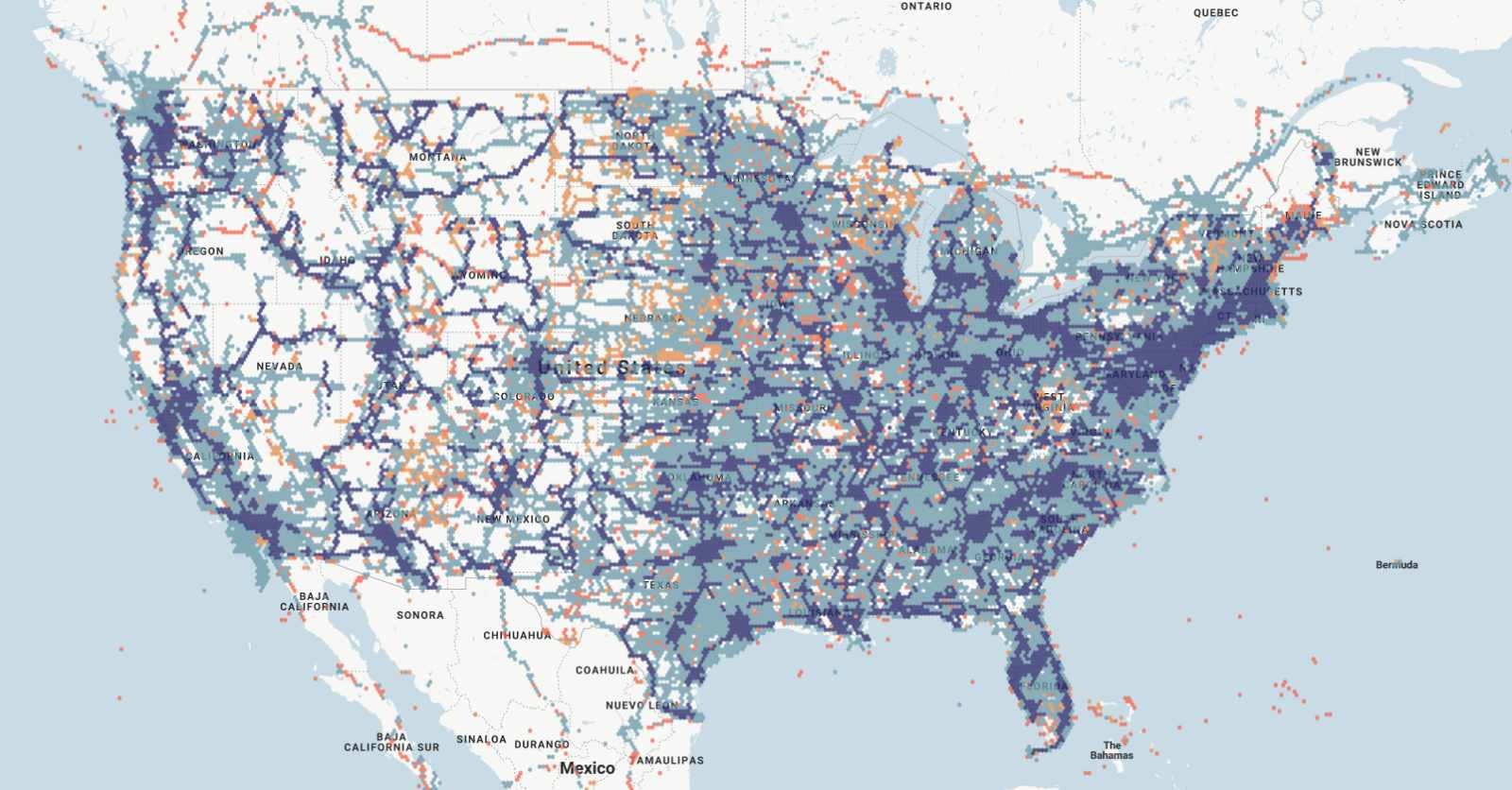
t-mobile coverage map

If you’d like, you can check T-Mobile's coverage in your area by using the following resources:

You can also download and use the following applications to see if T-Mobile offers good coverage in your area:

T-Mobile

LTE and 5G Bands

See what LTE and 5G bands
T-Mobile
uses to provide coverage.

T-Mobile LTE bands: 2, 4, 12, 25, 26, 41, 66, 71

T-Mobile 5G bands: n41, n71, n260, n261

The bands in bold are T-Mobile's primary bands that they use for LTE and 5G coverage. Make sure your phone supports these LTE and 5G bands for the best coverage, performance, and data speeds on the T-Mobile network.
T-Mobile

LTE Bands Explained

Understand what LTE bands
T-Mobile
uses for coverage, how they use them, and which LTE bands are most important.
  • Band 4 (1700/2100 MHz): Band 4 is one of the primary bands T-Mobile uses for its LTE network. It’s typically deployed in 20x20MHz blocks in major markets. Tutella reported that band 4 accounted for 9% of T-Mobile’s mobile data by volume as of September 2020.
  • Band 66 (1700/2100 MHz): Band 66 includes the same frequency blocks as Band 4, but adds a few additional blocks of spectrum. The additional blocks are G, H, I, and J (collectively referred to as AWS-3), and a chunk at the end referred to as AWS-4. AWS stands for “Advanced Wireless Services” because the frequency bands were primarily used for newer network technologies, like 4G LTE. Band 66 is another one of T-Mobile’s core LTE bands. Tutella reported band 66 accounted for 48% of T-Mobile’s network traffic.
  • Band 2 (1900 MHz): T-Mobile uses band 2 predominantly in rural areas of America, particularly in locations where band 4 is not available. Band 2 travels a greater distance than band 4 and can create larger coverage areas with fewer cell sites. Band 2 is deployed in a variety of configurations in different markets, including 5x5MHz blocks and 20x20MHz blocks. Traffic on band 2 made up 31% of T-Mobile’s total mobile data by volume, and it is another one of T-Mobile’s primary LTE bands.
  • Band 12 (700 MHz): T-Mobile has been using Band 12 as a supplemental band to their LTE network. Its lower 700MHz frequency allows band 12 to travel greater distances and to have better penetration within buildings. Band 12 helps increase coverage and performance across a wide range of markets. 
  • Band 71 (600 MHz): Similar to band 12, band 71 is used as a supplemental band to T-Mobile’s LTE network. Band 71’s lower frequency of 600MHz gives it even better building penetration than band 12 and allows it to travel greater distances. T-Mobile refers to bands 12 and 71 as its “Extended Range LTE” and promotes that the signal on these bands reaches 2x as far and has 4x better coverage in buildings.
  • Band 41 (2500 MHz): Band 41 is one of the three bands T-Mobile acquired from Sprint in the Sprint-T-Mobile merger. T-Mobile is currently using band 41 as one of its primary bands in its mid-band 5G network to add additional downlink capacity in certain markets. In some areas, band 41 is also being used to supplement LTE coverage and performance. In LTE markets band 41 is typically found deployed in 20x0MHz blocks. Eventually, band 41 will be used exclusively for 5G coverage
    Band 25 (1900 MHz)
    : Band 25 is another band T-Mobile acquired from Sprint. Band 25 is a superset of band 2, meaning that it includes all the frequencies of band 2, referred to as “PCS” and including blocks A-F, plus a newer set of frequencies called the “G block”.

T-Mobile

5G Bands Explained

Understand what 5G bands
T-Mobile
uses for their network coverage, how they use them, and which 5G bands are most important.
  • Band n71 (600 MHz): Band n71 is T-Mobile’s part of T-Mobile’s low-band 5G network. T-Mobile added 5G to band 71 in late 2019. The lower 600MHz frequency of band n71 allows it to travel great distances and have excellent building penetration, which is one of the main reasons T-Mobile’s 5G coverage map is so large. Band n71 is split into seven blocks of equal size, blocks A, B, C, D, E, F, and G, which each have 10MHz of total spectrum and are typically deployed in 5x5MHz blocks. Unfortunately, because the uplink and downlink channels are so narrow on each of the blocks, n71 typically has poor 5G performance and capacity. 
  • Band n41 (2.5 GHz): Band n41 is one of T-Mobile’s primary 5G bands in their mid-band (Sub-6GHz) 5G network because it can handle a large amount of data at high speeds. T-Mobile is currently band n41 to add extra downlink capacity to their mid-band 5G network. n41 has been found deployed in 60x0MHz blocks.
  • Band n260 (39 GHz): Band n260 is one of T-Mobile’s mmWave 5G bands. It has a HUGE amount of spectrum behind it and can support insanely fast speeds over shorter distances. The channel sizes are typically 50MHz, 100MHz, 200MHz, or even 400MHz. T-Mobile is actively building out its mmWave 5G network and it is available in a limited selection of markets.
  • Band n261 (28 GHz): Band n261 is also one of T-Mobile’s mmWave 5G bands. This means that n261 has a HUGE amount of spectrum behind it and can support insanely fast speeds over shorter distances. Typically the channel sizes are 50MHz, 100MHz, 200MHz, or even 400MHz. T-Mobile is actively building out its mmWave 5G network and it is available in a limited selection of markets.

Browse More

T-Mobile

Cell Phone Plans

Shop Unlocked Phones

An unlocked phone means it isn't tied to any carrier or contract. It's perfect to use with any plan you want.

T-Mobile

News

The latest news, deals, and updates in the world of cell phones.
person holding iphone with T-Mobile logo on screen
T-Mobile Review 2022: Should You Switch?
March 23, 2022
three iPhones standing vertically on desk with T-Mobile, Verizon, and AT&T logos displayed on screen
T-Mobile vs Verizon vs AT&T: The Ultimate Plan Comparison
March 22, 2022
three iPads standing vertically on a desk with an AT&T logo, Verizon logo, and T-Mobile displayed on their screens
T-Mobile vs Verizon vs AT&T Tablet and Hotspot Plan Comparison
March 22, 2022
three iPhone 12s standing vertically on desk with T-Mobile, Verizon, and AT&T logos on the screens
International Add-On Comparison: T-Mobile vs Verizon vs AT&T
March 22, 2022
four phones on desk with the US Mobile application open on the screen
US Mobile Review 2022: Is It Better Than Verizon Prepaid?
March 22, 2022
mint mobile unlimited plan review video
Mint Mobile's $30 Unlimited Plan Review
March 22, 2022
circledin review
CircledIn Review: A Platform to Join Family Plans for Group Savings
March 22, 2022
person holding iPhone with Metro by T-Mobile logo on it
Metro by T-Mobile Review 2022: Should You Switch?
March 22, 2022
iphone xs, galaxy s20 plus, and pixel 4 lying on table
These Are The Best Labor Day Smartphone Deals 2020
March 22, 2022
hand holding smartphone with Mint Mobile unlimited plan on screen
Mint Mobile Review 2022: Should You Make The Switch?
March 22, 2022

Browse All Cell Phone Plans

Browse the best cell phone plans, family plans, international eSIM plans, and more.